Coverage, read off the document
A dental plan is a calendar with a cap on it
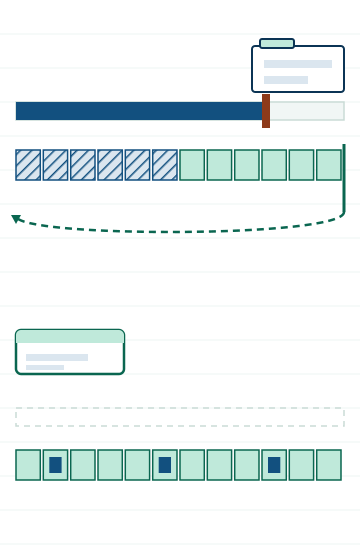
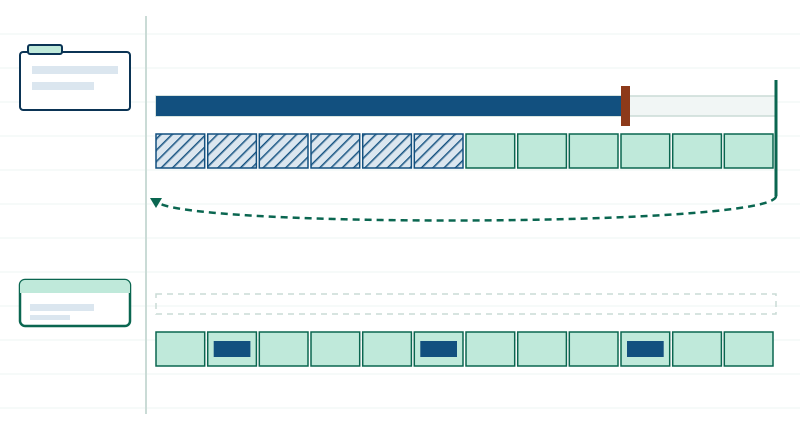
Three things decide what your dental cover is worth: when the plan will start paying, how much it will pay before it stops, and the date the counter goes back to zero. Everything else is detail. This site reads those three things off published plan documents and shows you where they sit — including the product that has none of them, because it is not insurance at all.
How to read this site
What this is
Plan documents, not adverts
Every figure here is lifted from a document a plan publisher or a government agency put its name to, with the day we read it beside it. Where a company would not show us its terms, we print no number at all.
What this is not
Nobody here can sell you a plan
We hold no insurance licence, so no insurer can pay us and none is linked. That also means you will never read "the best dental insurance" on this site — only how the parts work, so you can price your own mouth against your own plan.
The free answer
Sometimes the answer costs nothing
If you are between jobs or on a low income, a federally funded health centre, a dental school clinic or your state's Medicaid programme may matter far more than any plan. None of those pays us a penny, and they are on the seniors page and the money page anyway.
The three questions this site answers
A dental plan is easier to judge than it looks, because almost everything that matters is answered by three questions. When will it pay? How much will it pay in one year? And what happens to the part you did not use?
The first question is the waiting period. The 2026 Covered California Delta Dental PPO Family Dental plan answers it for its adult tiers in one line: major services are limited to enrollees who have been enrolled in the contract for six consecutive months, waived with proof of prior coverage. The second is the annual maximum: the same plan caps adult benefits at $1,500 a contract year, and defines that year as the twelve months starting on your effective date. The third has no kind answer. When the year turns over, whatever the plan did not spend on you is simply gone.
Those three answers explain more about a plan than any brochure adjective. A plan with no waiting period and a $1,500 cap behaves differently from one with a six-month wait and the same cap, and both behave differently again from a plan with no cap at all — the 2026 BCBS FEP Dental brochure has one of each, in the same document.
Why there is no "best plan" page here
Nobody writing this site holds an insurance licence, so this site cannot be paid for an insurance sale and does not accept one. The National Association of Insurance Commissioners describes an insurance producer as an individual who sells, solicits, or negotiates insurance, and says state insurance regulators license them. Being paid to point you at a policy is that activity, and we are not licensed to do it.
The practical result is the shape of this site. Insurers are named where their own published documents say something useful, quoted with the date we read them, and linked nowhere. There is no ranking, no score and no "our pick", because there is no honest way for us to produce one and no way for you to check it. What there is instead is the machinery: how insurance and discount plans differ, part by part, and what each part does to a real bill.
Where the money actually goes
The uncomfortable arithmetic is that most people never reach the cap they are paying to have. The National Association of Dental Plans says on its consumer explainer that, between 2014 and 2023, less than 5% of enrollees on average reached their annual benefit maximum; a separate release it dated 25 November 2025 put the 2024 share of group dental PPO members who reached it at 2.9%, up from 1.7%. A cap that almost nobody touches is not the part of the plan doing the work; the twice-yearly cleaning almost certainly is.
That cuts both ways. If your year is a cleaning and a filling, the maximum is irrelevant and the premium is the whole question. If your year is a crown, a root canal and a bridge, the maximum is the only number that matters, and it will run out in the middle of the treatment plan rather than politely at the end of it.
What a dental plan cannot be asked
No plan document can tell you what your mouth needs. Only a licensed dentist who has examined you can do that, and the order of operations matters: find out what the work is, get it written down with the procedure codes on it, and only then work out who pays for what. A plan bought against a guess is a plan bought against the wrong year.
If cost is the obstacle rather than the plan, the National Institute of Dental and Craniofacial Research points to dental schools, dental hygiene schools and federally funded health centres, where — in its words — you pay what you can afford, based on your income. Those routes pay this site nothing, and they are named on every page where they are the better answer.
Everything in the file
See all 10 →Discount Dental Plans, Explained Properly
A membership that lowers the fee and pays nobody anything. Here is the mechanism, the law that governs it, and the six things to check before paying.
Getting Dental Cover Without an Employer
Five routes exist, they open at different times of year, and two of them are not insurance at all. Here is what each one is and when you can use it.
What "Full Coverage" Dental Insurance Really Means
Nobody defines the phrase, so it means whatever the seller wants. What is defined is the coverage tier table — and that is where the answer actually lives.
Dental and Vision Bundles: Two Products, One Bill
A bundle is two separate policies sold together. The saving is real or it is not — and you can only tell by pricing each half on its own.
Two Dental Plans at Once: What the Second One Pays
Two plans do not mean two payouts. A published worked example shows a second plan paying $12.50 where, on its own, it would have paid $51.10.
Supplemental Dental Insurance: What the Word Means
"Supplemental" is not a defined product. It is used for two different things, and only one of them behaves the way buyers expect.